Developing Expertise in Modeling Ballistics and Explosive Loading
On January 28-29, 2026, employees of our department: Rafał Michalczyk and Kazimierz Józefiak, along with PhD students: Jędrzej Pawłowski and Piotr Piwowarski, participated in a training course titled "Ballistic Impacts in ANSYS LS-Dyna," organized by MESco. The main thematic focus of the meeting was the numerical modeling of nonlinear dynamics and extreme loads, with particular emphasis on the mechanics of ballistic impacts, the effects of explosives, and shock wave propagation in various media.
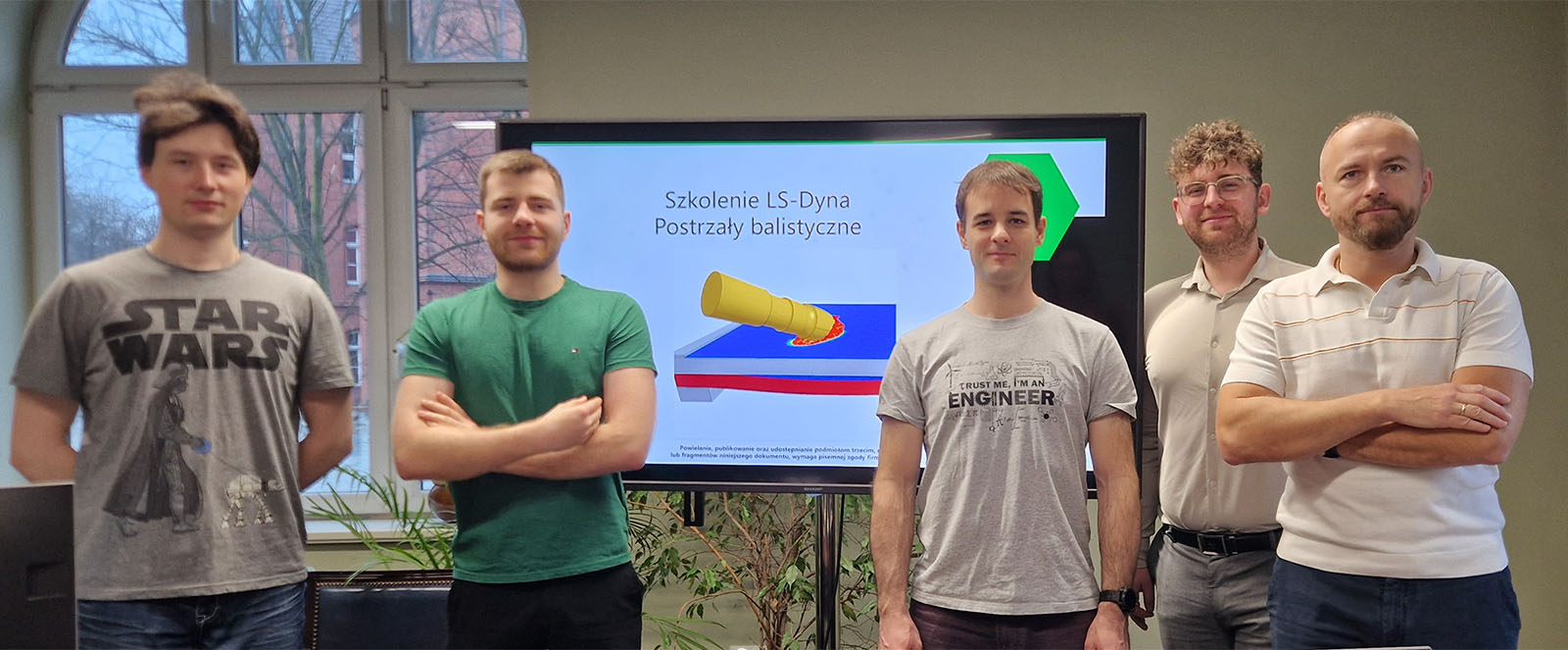
During the meeting, methods for simulating the penetration and perforation of barriers were analyzed. The limitations of classical FEM methods and the Lagrangian formulation in ballistic analyses were highlighted, demonstrating the transition to ALE (Arbitrary Lagrangian-Eulerian) and S-ALE formulations, and subsequently to meshless SPH (Smoothed Particle Hydrodynamics) techniques. An essential element of such simulations is always the implementation of appropriate material models for metals, ceramics, and concrete, incorporating the physical criteria of erosion and failure. Working on specific case studies – including the Taylor test, penetration of reinforced concrete with explicit modeling of the reinforcement, impacts on layered composite systems, and the direct effects of an explosion on a building structure – allowed for expanding knowledge in the analysis of highly deforming structures.
The systematic expansion of our numerical modeling capabilities in the field of dynamics allows our team to carry out increasingly complex research projects. Mastering the methods of modeling ballistic and explosive loads in LS-DYNA provides a foundation for the virtual prototyping of structures exposed to such effects. The numerical experiment techniques we are developing successfully support research and development processes, enabling the analysis of phenomena where traditional laboratory and field tests are difficult to perform, dangerous, or associated with very high costs.
Explosion simulation in LS-DYNA: the effect of TNT charge mass on the failure of reinforced concrete beams.